

This week in Five Dink Friday 😀
💍 The Dream Proposal — the innocent question that changed my life forever 😂
👀 The 4 Tells — learn to predict your opponent’s next shot before they hit it
🎯 Find Their Weak Spot — Zane’s checklist for dissecting any opponent in minutes
🟡 Advice Needs an Asterisk — when pickleball advice can actually hurt your game
⚡ The Off-the-Bounce Speedup — the masterclass to improve your attacks
Let’s get to it!
#1 💍 The Dream Proposal

This meme is funny, but it should come with a fair warning cuz as someone who swore I’d NEVER get married again…
this is how it all started. 😉
#2 👀 The 4 Tells Every Pickleball Player Gives Away
One of my favorite rabbit holes lately has been learning how to read my opponents instead of just reacting to them.
Because if you can anticipate the shot before it leaves their paddle…
you’ve already won half the battle.
This video breaks down four tells almost every recreational player gives away:
🎯 Paddle Face → tells you where the ball is going.
🏃 Body Position → tells you what type of shot is coming.
💪 Backswing → tells you how hard they’re about to hit it.
👀 Eyes → often reveal their intended target before they swing.
Simple.
Brilliant.
I was already doing three of the four without really thinking about it.
I’ve learned to watch the paddle face.
I pay attention to body position.
And I definitely notice when someone takes a giant backswing.
But…
I don’t think I’ve ever consciously watched someone’s eyes.
Apparently, most players glance exactly where they’re about to hit.
So this week’s experiment is simple:
I’m going to see if I can start anticipating my opponent’s next move by watching their eyes.
Now…
Whether I can watch:
👀 their eyes
🏓 their paddle face
💪 their backswing
📍 where my partner is
⚪ AND the ball…
…without completely whiffing it?
We’ll find out. 😂
Side Note:
These tell work both ways.
I need to work on deception and disguise cuz now I know that my opponent is going to be watching my paddle face, body position, backswing, and eyes.
I don’t want to be an easy read . . .
This one’s definitely worth the watch if you want to become a better anticipator—and an unpredictable player.
#3 🎯 How to Find Your Opponent’s Weak Spot(s)
Learning to read your opponent so you can better anticipate their next shot is clutch.
Learning how to quickly identify—and exploit—their weaknesses?
That’s next level.
Zane Navratil walks through exactly how he scouts an opponent, and naturally, I had to take copious notes so I’d remember it the next time I step on the court.
Here’s the checklist I made for myself (hopefully it helps you too):
🕵️ Physical Characteristics
Young or older?
Tall or short?
Long wingspan?
Athletic mover?
Quick hands?
You can make a surprising number of educated guesses before the first serve is even hit.
⸻
🏓 Ready Position
This one fascinated me.
Where do they naturally hold their paddle?
Paddle low?
Paddle high?
Forehand biased?
Backhand biased?
Low athletic stance?
Standing upright?
Their ready position tells you a lot about the shots they want to hit before they ever swing.
⸻
✋ Grip
I’ve honestly never looked at someone’s grip.
Now I will.
Every grip has strengths…
and weaknesses.
If I can recognize their grip, I can start predicting which shots they’ll favor…and which ones they’ll avoid.
⸻
🥒 During Dink Rallies
This was another gold mine.
Ask yourself:
• Do they bail out of backhand exchanges?
• Do they avoid certain shots?
• Do they run around their backhand?
• Do they hold the kitchen line…
or constantly back up?
• Are their dinks consistent…
or are they spraying balls high and low?
Every answer tells you something.
Every pattern reveals confidence…
or a weakness waiting to be exposed.
⸻
⚡ Hands Battles
Are they:
✔️ Compact?
✔️ Calm?
✔️ Reloading quickly?
Or…
Are they taking giant swings?
Guessing?
Getting jammed?
Losing balance?
Those are players I’m attacking every chance I get.
⸻
🚶 Transition Zone
This was the biggest gem for me.
If one player struggles in transition…
return to THEM.
I usually return to the player with the weaker third shot…
or to the player who’s an absolute poaching maniac so I can keep them back.
But I’d never thought about intentionally returning serves based on who has the weaker transition game.
That one idea alone was worth watching the video.
I’m absolutely testing it this week.
⸻
🧠 Biggest Takeaway?
I realized I need to start studying my opponents the same way I study my business’s P&Ls.
Not just:
“Can they hit this shot?”
But…
“Where are they uncomfortable?”
And maybe even more importantly…
I want to start studying my own game.
Because if Zane can identify all of these tendencies after watching someone for just a few minutes…
what are my opponents seeing when they watch me?
Do I actually hold the kitchen line…
or do I retreat more than I realize?
Do I stay low…
or do I just feel low? 😂
Every pro and high-level coach recommends recording yourself and watching the film.
Meanwhile…
I’ve never watched a single game of myself.
I’d love to tell you that’s changing this week…
but my iPhone has approximately three bytes of storage left. 😅
So until this phone finally gives up the ghost (which is apparently my preferred upgrade strategy), I’ll keep relying on my friends to tell me when I look like I’m casually out for a Sunday stroll instead of ready for a firefight at the kitchen.
#4 🚦Good Advice…But Don’t Forget the Yellow Zone
I came across a reel this week that said:
“Stop resetting high balls.”
At first I thought…
“Yeah…that makes sense, and I do want to work on being more aggressive in the transition zone.”
So I tried it a couple of times in this week’s games.
And I realized the advice to stop resetting high balls is great…
if you understand the context.

An important distinction this tutorial left out—which IMHO is pretty important—are what I like to call the zones:
🔴 Red Zone = Below the net (or below your knees).
No hero shots here.
Reset it.
🟡 Yellow Zone = Around net height or waist height.
Proceed with caution.
This is where good judgment separates advanced players from everyone else.
🟢 Green Zone = Chest high or higher.
Attack.
That’s your put-away ball.
The reel basically skipped right over the yellow zone and jumped from:
“Reset low balls…”
to…
“Attack high balls.”
Which sounds great…
until you start playing 4.5+ players.
Because here’s what I’ve learned…
At the higher levels, an aggressive drive from the transition zone on a yellow-zone ball often comes screaming right back at your feet…
…or worse…
your partner’s feet. 😅
Unless it’s truly a green-light put-away…
or you’re exceptional at jamming someone in the chicken wing or hips…
I’ve found that a quality drop usually wins more points than trying to force an attack from the transition zone.
Sometimes, earning your way to the kitchen is the most aggressive play you can make.
Now…
This reel also suggested that if someone rips a FAST ball at you that’s already chest high in the transition zone…
let it go.
That ball is probably sailing long.
Notice the key word:
FAST.
Because if you leave that word out…
you’ll start letting slow, chest-high topspin balls drop right inside the baseline.
Big difference.
That’s why I think experience and context matter.
The internet loves absolute rules.
Real pickleball doesn’t.
🧠 My Biggest Takeaway?
As you improve, you’ll stop asking:
“Is this good advice?”
And start asking:
“In which situations is this advice good?”
That’s when you know you’re improving.
#5 ⚡ The Off-the-Bounce Speedup Masterclass
If you want a good video covering all the deets of the off-the-bounce speedup, John Cincola and Zane Navratil absolutely nerded out on every little detail…
I’ve been intentionally adding more off-the-bounce speedups to my game lately, so this one couldn’t have come at a better time.
The biggest takeaway?
Before you even THINK about attacking…
run through this mental checklist.
✅ Are you behind the ball?
✅ Is your paddle tip down?
✅ Did your opponent give you a dead dink that sits up enough to attack?
If the answer isn’t yes to all three…
keep dinking.
Wait for a better opportunity.
⸻
🎯 Then Comes the Fun Part…
Once you’ve earned the attack…
your target matters just as much as your mechanics.
John talked about attacking:
• through the body
• down the line
• crossbody
And I loved that he emphasized, “Placement beats power.”
A difference of six inches can determine whether your speedup wins the point…
…or gets countered right back at your feet.
⸻
🥷 The Secret Sauce?
Hold the dink.
Everything should look exactly like another dink…
…until the very last second.
If you’re attacking down the line…
push through it.
If you’re attacking crossbody…
that’s where the little tip-down to tip-up wrist flick comes in.
The beautiful part?
The setup looks almost identical.
Your opponent shouldn’t know which one you’re hitting until it’s already gone.
James Ignatowich teaches almost the exact same concept in one of his Instagram tutorials.
He explains that by keeping the paddle tip down as long as possible, you give yourself the freedom to change your mind at the last second and become far more deceptive.
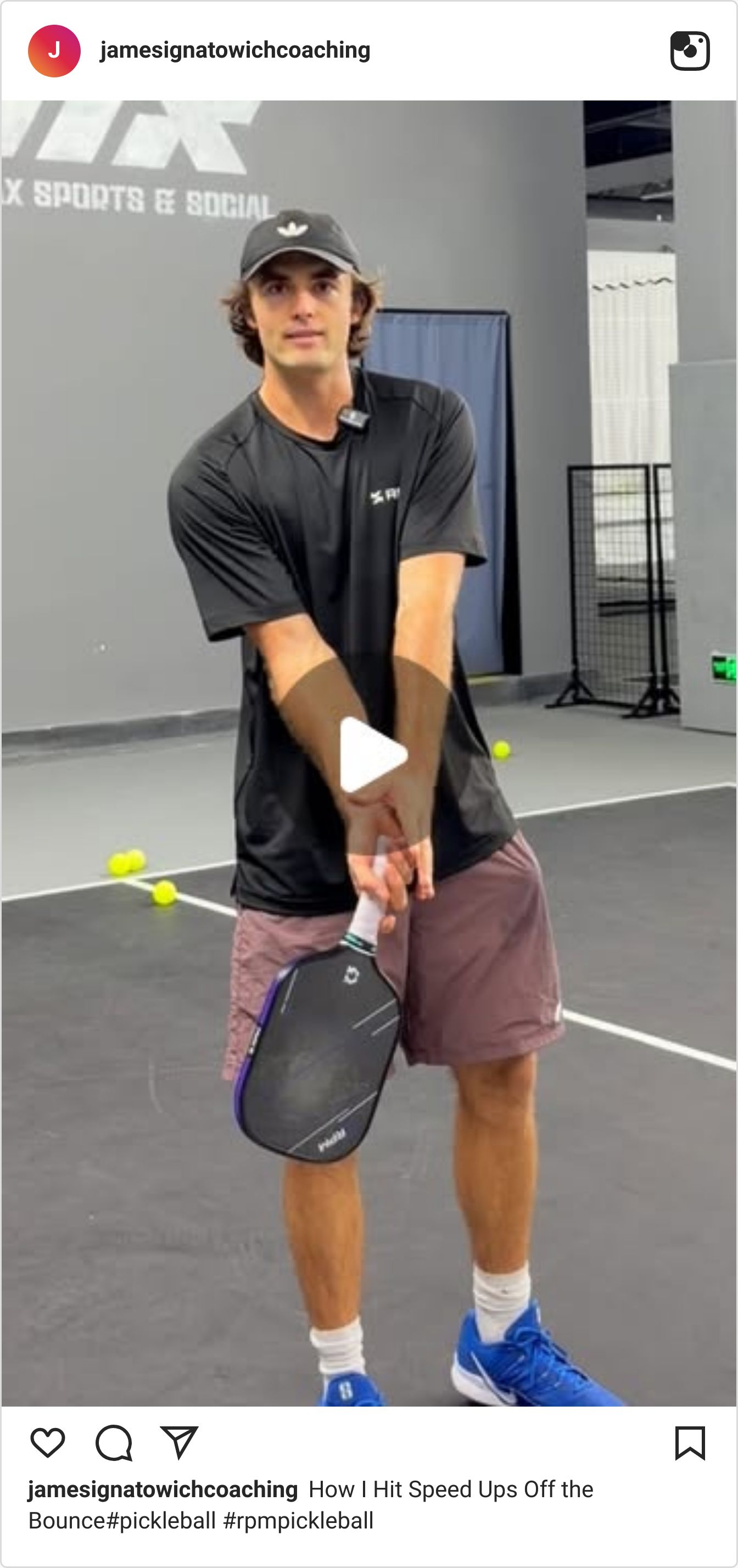
Deception is key.
⸻
👀 Here’s Something Interesting…
The more I’ve studied the off-the-bounce speedup…
the easier it’s become to recognize when my opponents are about to hit one.
In fact, I’ve actually started baiting my opponents.
I’ll intentionally feed a dead dink through the middle…
knowing they’re probably going to speed it up.
Then…
I’m already sitting there waiting.
Locked and loaded.
Ready to send it right back at their feet.
Works like a charm…
…unless my partner decides they’re taking the middle. 😂
⸻
🧠 Additional Takeaway..
The mechanics for the off-the-bounce speedup…
are the same mechanics you’ll use on an out-of-the-air speedup.
Which means this tutorial is a twofor (two for one) 🤩
💥 That’s a wrap for this week’s Five Dink Friday!
If this week’s edition made you start looking at your opponents a little differently…
…and maybe wondering what you’re accidentally telling them…
…then my work here is done. 😏
If this landed in your inbox via a friend, hit subscribe so you don’t miss the next drop:
Until next time…
Stay observant.
Stay deceptive.
And remember…
The best players don’t just watch the ball.
They watch everything else.
See you on the courts.
— Janelle 🏓✨
🥒 P.S. — I finally tried the new sport Typti this week.
Supposedly, it’s one of the fastest-growing racquet sports, and it’s basically tennis played with a foam ball on a pickleball court.
Which…
I already have mixed feelings about cuz our pickleball courts are crowded enough. 😂

A group of 24 of us got together for a lesson, and I have to be honest…
It was…
meh.
Maybe if I were a former tennis player looking for something with a little less movement, I’d feel differently.
But for me?
It didn’t hold a candle to pickleball.
In fact, halfway through the lesson, my friend and I kept looking at each other like…
“Can we be done now so we can play pickleball?” 🤣
Honestly, it was a huge relief.
The last thing I need is another sport stealing time from my pickleball obsession.
Now I’m curious…
Have any of you tried Typti yet?
If so, what did you think?
And if you haven’t…
IMHO, you’re not missing much. 😏